






















Howdy, Stranger!

It looks like you're new here. If you want to get involved, click one of these buttons!


Shells Virtual Desktop
BMail.ag - Secure Email Service
Server.net
CPLicense.net
VPS Server
Buy VPN
Vultr
VMs for AI
HostDare
ReliableSite White-Label Dedicated Hosting for Resellers
InterServer VPS
BMail.ag - Secure Email Service
Best VPN
High-Performance Bare Metal Server Solutions
Karvl.com
Server Mania Cloud Hosting
DataWagon Hosting
AlphaVPS Hosting
Evoxt.com
Clouvider
VPS Hosting with NVMe
Residential IPs in the US & 4G Mobile Proxies in EU & US with Unlimited Bandwidth
ReliableSite White-Label Dedicated Hosting for Resellers
Rabisu - Hosting Solutions
Shells Virtual Desktop
New on LowEndTalk? Please Register and read our Community Rules.

All new Registrations are manually reviewed and approved, so a short delay after registration may occur before your account becomes active.

Upstream provider Sharktech linked to data broker Team Cymru selling netflow data

2»

Comments

  • JosephFJosephF Member

    @forest said:

    @oriend said:
    So mullvad, windscribe... What about proton?

    As I wrote on another thread:

    @forest said:

    @JosephF said:

    @forest said:

    @Monocle said: Well, these are probably the most you can get from a VPN service. And they have somewhat proven themselves in court. Otherwise just use TOR.

    Not sure about Windscribe or Mullvad, but I would steer clear from ProtonVPN.

    Why?

    Because they have cooperated with law enforcement to deanonymize their VPN users (I can't find the resources for that, sorry) and have shown various other actions that are contrary to privacy and anonymity such as:

    • Misleading advertising that implies that they will go above and beyond to protect user's identities
    • Fighting against privacy-based cryptocurrencies while trying to promote their own non-private coin
    • Silently cooperating with authorities even when they have the technical and legal ability not to do so
    • Performing aggressive and non-privacy-preserving telemetry collection on many of their products

    Meanwhile, Mullvad has partnered with Tor Project to assist in research, browser development, and funding and, to the best of my knowledge, have never attempted to deanonymize their own users. As for Windscribe, I don't have the slightest idea.

    If you really care about anonymity, use Tor. It's the best tool out there.

    Wasn't it revealed a number of years ago US law enforcement was able to bust some activity conducted via Tor?

  • LeviLevi Member

    @JosephF said:

    @forest said:

    @oriend said:
    So mullvad, windscribe... What about proton?

    As I wrote on another thread:

    @forest said:

    @JosephF said:

    @forest said:

    @Monocle said: Well, these are probably the most you can get from a VPN service. And they have somewhat proven themselves in court. Otherwise just use TOR.

    Not sure about Windscribe or Mullvad, but I would steer clear from ProtonVPN.

    Why?

    Because they have cooperated with law enforcement to deanonymize their VPN users (I can't find the resources for that, sorry) and have shown various other actions that are contrary to privacy and anonymity such as:

    • Misleading advertising that implies that they will go above and beyond to protect user's identities
    • Fighting against privacy-based cryptocurrencies while trying to promote their own non-private coin
    • Silently cooperating with authorities even when they have the technical and legal ability not to do so
    • Performing aggressive and non-privacy-preserving telemetry collection on many of their products

    Meanwhile, Mullvad has partnered with Tor Project to assist in research, browser development, and funding and, to the best of my knowledge, have never attempted to deanonymize their own users. As for Windscribe, I don't have the slightest idea.

    If you really care about anonymity, use Tor. It's the best tool out there.

    Wasn't it revealed a number of years ago US law enforcement was able to bust some activity conducted via Tor?

    Yes, and it does that to this day. FBI has very substantial amount of relay and exit nodes in tor network.

  • suyadi92suyadi92 Member
    edited March 23

    @xHosts this is the reason why we don't want to do KYC

  • @buzzyLET said: about it as if it's a honey pot

    Never trust any VPN. If I was a goverment trying to catch people I didn't like, the first order of business would be to build or purchase a privacy-oriented VPN brand. All the marketing about how their RAM-only VPN servers can't log you data is nonsense. RAM-only doesn't prevent sending log data over the network to some other server.

  • What providers claim they nor their upstreams do not sell netflow data?

  • @4pple5auc3 said:
    What providers claim they nor their upstreams do not sell netflow data?

    Cogent famously is one of the few (possibly only?) T1 carriers that does not sell flows.

    Thanked by 1WyvernCo
  • Thank you. Never thought I’d be looking for a Cogent only hosting company.

  • tentortentor Member, Host Rep

    @fluffernutter said:

    @4pple5auc3 said:
    What providers claim they nor their upstreams do not sell netflow data?

    Cogent famously is one of the few (possibly only?) T1 carriers that does not sell flows.

    From what I see, it is only a claim.

  • ObelousObelous Member

    @tentor said:

    @fluffernutter said:

    @4pple5auc3 said:
    What providers claim they nor their upstreams do not sell netflow data?

    Cogent famously is one of the few (possibly only?) T1 carriers that does not sell flows.

    From what I see, it is only a claim.

    The article is also from 2021 so it's very possible they changed their mind.

    Thanked by 1tentor
  • buzzyLETbuzzyLET Member
    edited March 24

    @Levi said:

    @JosephF said:

    @forest said:

    @oriend said:
    So mullvad, windscribe... What about proton?

    As I wrote on another thread:

    @forest said:

    @JosephF said:

    @forest said:

    @Monocle said: Well, these are probably the most you can get from a VPN service. And they have somewhat proven themselves in court. Otherwise just use TOR.

    Not sure about Windscribe or Mullvad, but I would steer clear from ProtonVPN.

    Why?

    Because they have cooperated with law enforcement to deanonymize their VPN users (I can't find the resources for that, sorry) and have shown various other actions that are contrary to privacy and anonymity such as:

    • Misleading advertising that implies that they will go above and beyond to protect user's identities
    • Fighting against privacy-based cryptocurrencies while trying to promote their own non-private coin
    • Silently cooperating with authorities even when they have the technical and legal ability not to do so
    • Performing aggressive and non-privacy-preserving telemetry collection on many of their products

    Meanwhile, Mullvad has partnered with Tor Project to assist in research, browser development, and funding and, to the best of my knowledge, have never attempted to deanonymize their own users. As for Windscribe, I don't have the slightest idea.

    If you really care about anonymity, use Tor. It's the best tool out there.

    Wasn't it revealed a number of years ago US law enforcement was able to bust some activity conducted via Tor?

    Yes, and it does that to this day. FBI has very substantial amount of relay and exit nodes in tor network.

    Recently saw this article was skeptical at first but I don't love these connections to government from Tor... https://bible.beginnerprivacy.com/opsec/torhoneypot/

    Links between Tor and Cymru as well. sigh

  • forestforest Member
    edited March 24

    @Levi said: Yes, and it does that to this day. FBI has very substantial amount of relay and exit nodes in tor network.

    Actually, the majority of nodes are run by people who are well-known in the community. The way Tor is attacked usually involves guard discovery attacks which do not require running nodes. Tor is not perfect, but there is no evidence that feds are running even a small fraction of the network. The most effective attacks don't require running nodes anyway.

    With that said, the latest attack against Tor took years, an entire major German ISP assisting for a prolonged amount of time, and international cooperation to catch a few people, one of whom was only caught because they were using an outdated version of Tor running a hidden service themselves (a bad idea given guard discovery attacks are easier against HSes) that lacked the vanguards mitigation, along with some minor opsec mistakes.

    If you're interested in learning about some of the real vulnerabilities (which are more involved than a mere sybil attack), it's documented pretty well on prop344: https://spec.torproject.org/proposals/344-protocol-info-leaks.html

    @buzzyLET said: Links between Tor and Cymru as well. sigh

    Yeah, Team Cymru was kicked out of Tor a few years ago because of the huge conflict of interest.

    Interestingly, the most effective attack against Tor is disinfo to scare people off of it and onto less secure platforms.

    Thanked by 1stable_genius
  • @forest said:

    @Levi said: Yes, and it does that to this day. FBI has very substantial amount of relay and exit nodes in tor network.

    Actually, the majority of nodes are run by people who are well-known in the community. The way Tor is attacked usually involves guard discovery attacks which do not require running nodes. Tor is not perfect, but there is no evidence that feds are running even a small fraction of the network. The most effective attacks don't require running nodes anyway.

    With that said, the latest attack against Tor took years, an entire major German ISP assisting for a prolonged amount of time, and international cooperation to catch a few people, one of whom was only caught because they were using an outdated version of Tor running a hidden service themselves (a bad idea given guard discovery attacks are easier against HSes) that lacked the vanguards mitigation, along with some minor opsec mistakes.

    If you're interested in learning about some of the real vulnerabilities (which are more involved than a mere sybil attack), it's documented pretty well on prop344: https://spec.torproject.org/proposals/344-protocol-info-leaks.html

    @buzzyLET said: Links between Tor and Cymru as well. sigh

    Yeah, Team Cymru was kicked out of Tor a few years ago because of the huge conflict of interest.

    Interestingly, the most effective attack against Tor is disinfo to scare people off of it and onto less secure platforms.

    Hey thanks for this, was hoping you would respond because I wasn't sure about that info. Glad to hear Cymru isn't involved anymore.

    Thanked by 1oloke
  • forestforest Member
    edited March 24

    @buzzyLET said: Hey thanks for this, was hoping you would respond because I wasn't sure about that info. Glad to hear Cymru isn't involved anymore.

    When they first joined the project, they were only a generic security company that was interested in networking and helped provide infrastructure. They later evolved into the data broker they are now, and when that was uncovered, they got removed.

    People love to jump into conspiracies wrt Tor and its limitations, but the actual dangers are not feds donating to Tor to influence them or infiltration of the organization or running the majority of the network (all oft repeated, easy to remember and repeat, but unfalsifiable claims). The real dangers, with varying levels of feasibility, are:

    • Crypto tagging attacks
    • Guard discovery attacks
    • WF fingerprinting
    • Augmentation of existing attacks with traffic flow information
    • Exit-to-relay covert side-channels
    • Bandwidth inflation attacks
    • Path-bias attacks
    • Exploits against Firefox ESR

    But those are less catchy and harder to repeat and explain than "Tor is a honeypot because feds".

    Thanked by 1oloke
  • forestforest Member

    @eezcloud said: RAM-only doesn't prevent sending log data over the network to some other server.

    Nor simply logging in and checking existing connections in real time when investigating abuse, which is what these companies typically do. That way they can still pass 3rd party audits without lying about not keeping logs, simply because they don't need to in order to deanonymize someone.

    Thanked by 1oloke
  • matey0matey0 Member

    You often see netflow data used by security companies like Recorded Future. They're able to map multi-tiered/proxied threat actor infrastructure and identify which IPs have prolonged ssh connections to the backend, for example.
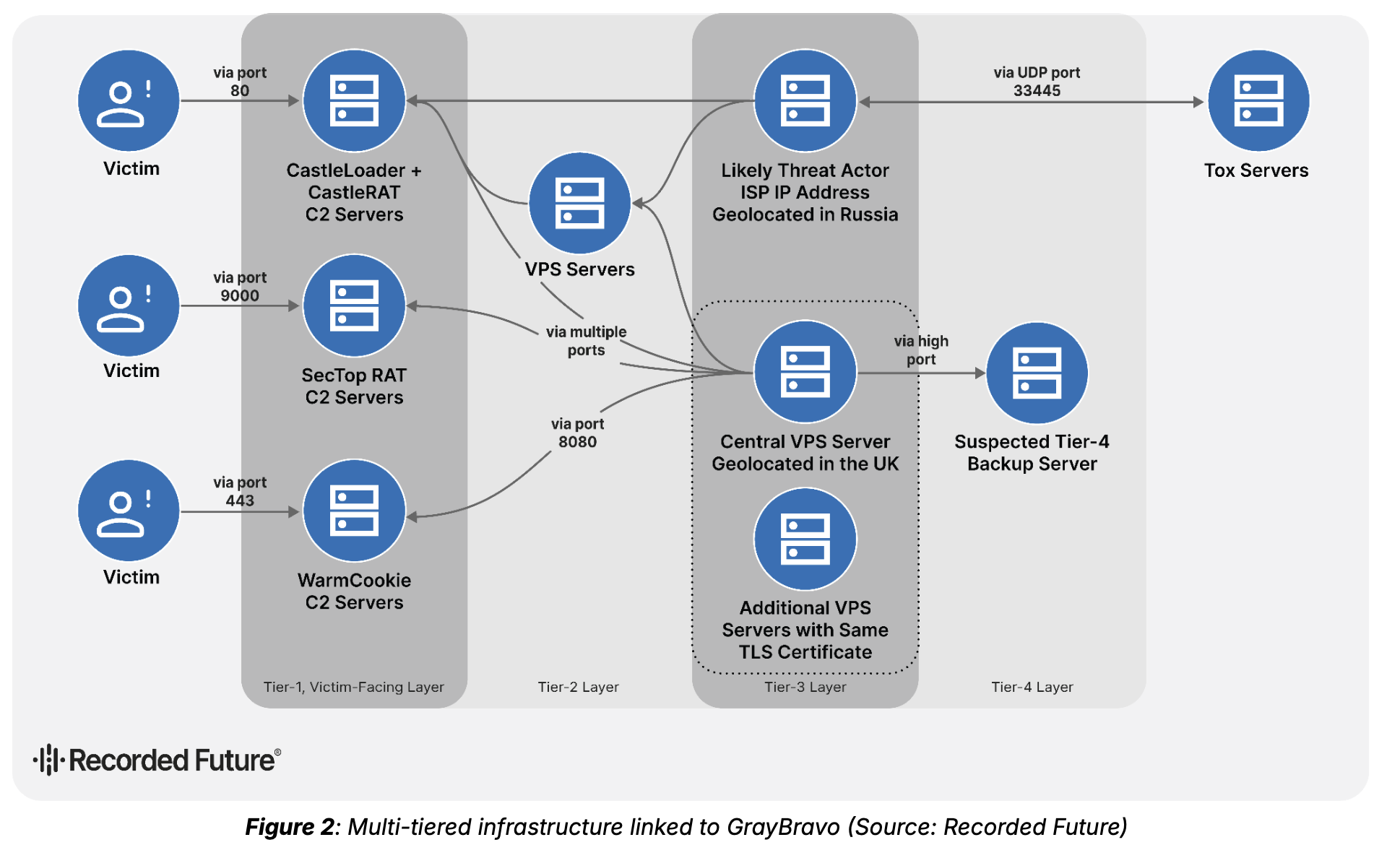
    Doesn't seem far off that this could deanonymize multi-hop VPNs, Tor or I2P. At least in targeted cases.

  • forestforest Member
    edited March 24

    @matey0 said: Doesn't seem far off that this could deanonymize multi-hop VPNs, Tor or I2P. At least in targeted cases.

    Yep, that's why it's so important to fight against the centralization of Tor in the Netherlands and Germany, as it makes traffic information recorded by just a few exchanges more valuable. Tor does have some features that make NetFlow-type information less valuable, but it's not invincible.

  • buzzyLETbuzzyLET Member
    edited March 24

    @forest said:

    @matey0 said: Doesn't seem far off that this could deanonymize multi-hop VPNs, Tor or I2P. At least in targeted cases.

    Yep, that's why it's so important to fight against the centralization of Tor in the Netherlands and Germany, as it makes traffic information recorded by just a few exchanges more valuable. Tor does have some features that make NetFlow-type information less valuable, but it's not invincible.

    Can you explain further why the centralization is bad? Because they could be linked to the same netflow data broker? I always assumed it was due to the favorable Tor laws in those countries

    Thanked by 1oloke
  • forestforest Member

    @buzzyLET said:

    @forest said:

    @matey0 said: Doesn't seem far off that this could deanonymize multi-hop VPNs, Tor or I2P. At least in targeted cases.

    Yep, that's why it's so important to fight against the centralization of Tor in the Netherlands and Germany, as it makes traffic information recorded by just a few exchanges more valuable. Tor does have some features that make NetFlow-type information less valuable, but it's not invincible.

    Can you explain further why the centralization is bad? Because they could be linked to the same netflow data broker? I always assumed it was due to the favorable Tor laws in those countries

    It's bad because the circuits have a higher potential to go through the same few ASes. At the moment, there's a non-negligible chance that any given Tor circuit will have all three hops in OVH or Hetzner. The reason so many people run relays there is because bandwidth is very cheap.

    Thanked by 3384_cz Plioser oloke
  • matey0matey0 Member
    edited March 24

    @forest said:

    @matey0 said: Doesn't seem far off that this could deanonymize multi-hop VPNs, Tor or I2P. At least in targeted cases.

    Yep, that's why it's so important to fight against the centralization of Tor in the Netherlands and Germany, as it makes traffic information recorded by just a few exchanges more valuable. Tor does have some features that make NetFlow-type information less valuable, but it's not invincible.

    Nice that Tor has features that try to mitigate this, gonna look into that.
    I wonder if they could deanonymize traffic even if they don't have insight into every hop. Even in a paranoid ISP->VPN*...->Tor->(Optional proxy)->Internet setup, your exit node netflow is still somewhat correlated to your ISP input netflow, and together with AI traffic analysis that should allow them to narrow down a small list of suspects, at the very least.

    That being said, I've never seen something like that mentioned in any court documents. It's common to see "Suspect communicated with (VPN IP) at similar times when (VPN IP) communicated with (Victim IP)", but never with something like Tor. Could still be used to narrow down suspects to then collect more clear evidence on though.

  • forestforest Member
    edited March 25

    @matey0 said: I wonder if they could deanonymize traffic even if they don't have insight into every hop. Even in a paranoid ISP->VPN*...->Tor->(Optional proxy)->Internet setup, your exit node netflow is still somewhat correlated to your ISP input netflow

    Yep, that's generally possible, although not trivial unless you have a specific person you want to monitor. That's called an end-to-end correlation attack. The passive version is the least reliable. More reliable are active versions that tamper with the stream in order to send a covert signal to the other end (a so-called "tagging attack" where the exit uses a covert channel to encode, for example, the URL that was just visited). One of the most severe variants of this, called the crypto tagging attack, was recently prevented by overhauling Tor's cryptography.

    The purpose of the middle node is not to make end-to-end correlation attacks harder, but to decouple the guard (which knows who you are but not what you are visiting) from the exit (which knows what you are visiting but not who you are).

  • daviddavid Member

    The tweet says:

    Tzulo confirmed to us that an upstream that they use (Sharktech) was the culprit. Tzulo has already migrated off their network in two out of three locations they're used in. They mentioned that the ETA for migrating off the upstream for the third location is 2-3 months from now.

    Any idea which Tzulo location is still using Sharktech?

    I have a GreenCloud VPS in Phoenix that usees Tzulo.

  • daviddavid Member

    Possibly related; when I hear Sharktech, this is what I think about.

  • @david said:
    Possibly related; when I hear Sharktech, this is what I think about.

    They bought these IPs but this was actually from fdcservers. I asked them if I could get a VM with that IP for the funny and they said no :(

    Thanked by 1david
Sign In or Register to comment.