

























New on LowEndTalk? Please Register and read our Community Rules.
All new Registrations are manually reviewed and approved, so a short delay after registration may occur before your account becomes active.
All new Registrations are manually reviewed and approved, so a short delay after registration may occur before your account becomes active.




Comments
google for glue records, you set these up with the registrar usually.
Bunny DNS does that.
Sorry, already answerd above by FatGrizzly.
BIND9
https://bind9.net/
Open-source Self-hosted DNS
ns1.yourdomain.tld, ns2.yourdomain.tld
Well, google.com is already taken. I guess you'll have to think of something different.
You don't need to self-host if you don't want to; some DNS hosts let you white-label their service. ClouDNS allows this for example: https://www.cloudns.net/wiki/article/39/
I have same question as op, but I also want to use cloudflare with custom glue records. Cloudflare doesn't allow that... Unless I pay way more than what it's worth. What is an alternative CDN to cloudflare that allows this?
Bunny.net DNS is pretty easy to set up.
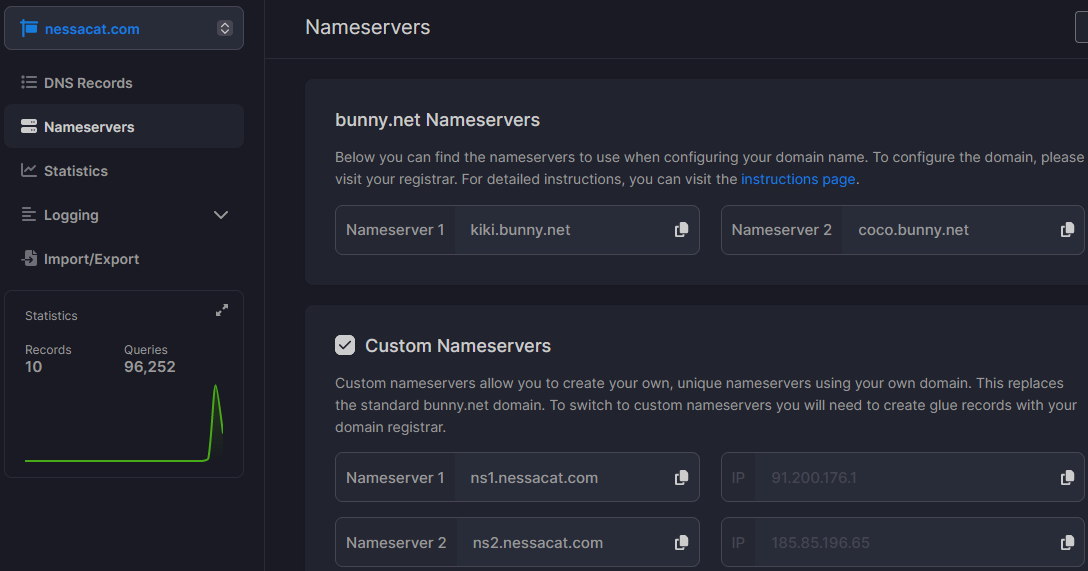
Thanks! I'll find good vps for host nameserver!
Is Cheap?
I know.
I mean google is using ns1/2/3/4.google.com for their domain google.com.
I wanna do similar like ns1/2/3/4.mydomain.tld with mydomain.tld.
It's free, can't get any cheaper than that.
Does HE.net allow this on their free DNS?
I do not know.... I think it's not
Overkill for a lot of use cases.
I prefer NSD.
few years ago, you can do that with Digitalocean for free with its free dns...dont know about now as not use its dns anymore..
I think ClouDNS can do that
"NS services" like mentioned by others can be a solution - but: what do you really gain, other than having all your domains' NS centralized, which btw. also can turn out to be a problem (SPOF, political issues, etc).
That's why I personally prefer to host my name servers myself and strongly suggest to, at the very minimum, have the authoritative NS master under your control, i.e. run it on a VPS.
(and not use 'bind'! There are way better options like e.g. NSD).
https://www.digitalocean.com/community/tutorials/how-to-create-vanity-or-branded-nameservers-with-digitalocean-cloud-servers
I did a tutorial on NSD a while back on LEB:
https://lowendbox.com/blog/setup-a-dns-nameserver-using-nsd/
For some reason I don't remember now, I didn't setup proper zone transfers with that tut but used rsync. I did in the later video:
I should probably do an updated tut on LEB. NSD works very well as an authoritative name server.
What's the practical differences between BIND and BSD?
BIND does both authoritative name serving and caching name serving.
NSD only does authoritative.
There's also djbdns, unbound on *BSD, and others.
Compare
I like NSD because it does what I want, and I've run it on very small systems (128MB in the past, though I no longer have VPSes that small).
Seriously?
Practical differences? One is an application, one is an operating system.
I'm finding managed solution with affrodable pricing
I think I am not good to setup it myself , and VPS has bandwidth limit
CoreDNS is OP
Yes, but gluerecords are not available for domain extensions from google.
I tried to use .app and .dev for my nameservers but apparently it wasn't technically possible.
Had to use a .com
I have no fucking idea why though, however this limitation is real.
TLDR: You can't use a google TLD for glue records if it points to another google TLD.
You have to use something else.
Yep, my experience over many years (as well as occasionally looking (again) at alternatives) confirms that.
That as well. I still have very small (<=256 MB) VPS running NSD perfectly well.
Yes_no. The guys behind NSD just split the two functionalities. The caching resolver is 'Unbound', also a fine daemon.
Btw, one of the main reasons I like NSD so well is that zone transfers (and control thereof) are easy and work well and reliably.
(And now I'll watch your video *g)
You guys aren't listening, the answer is always CoreDNS.
I took the freedom to complement that for you *g
Don't worry, unless you have very, very prominent domains and lots of them even 1 TB will be more than plenty enough.
Meh, oh well google ...
Strange that no one mentioned PowerDNS