






















Howdy, Stranger!

It looks like you're new here. If you want to get involved, click one of these buttons!


New on LowEndTalk? Please Register and read our Community Rules.

All new Registrations are manually reviewed and approved, so a short delay after registration may occur before your account becomes active.

LowEndTalk Selling Rules (Updated August 2026)

1…202122232426»

Comments

  • plumbergplumberg Veteran, Megathread Squad

    @angstrom said:

    Do you wish to elaborate?

    Ok

    Thanked by 2forest Murv
  • @angstrom said:

    Do you wish to elaborate?

    He is confirming his understanding, lol.

  • rpqurpqu Member

    Dear @jbiloh @raindog308 @angstrom,
    I'm proposing standardization over the generic term "unmetered" or "unlimited".
    If the "unlimited" or "unmetered" is shared, then it should have disclosure over the upper limit of the transferred data on the package, that provider can't rescind on their sole discretion at later date as long as the original contract is in effect (provider may choose to not renew the contract or change the content or capped number of packets per second × MTU = port size}

    As an example :

    1G (333TB out) # Only outgoing data counts
    10G (333TB in+out) # Both direction counts
    10G (333TB in/out) #Each direction counts, on separate counter
    10G (3333TB/333TB out) #asymmetric quota
    10G (X TB out, next X TB @100mbps, next X TB @100mbps gradually goes to 5mbps, next X TB at 5mbps) # @PulsedMedia standard

    CC: @averagedatahoarder @forest @cloudblast @servury @Advin @xHosts @DeluxHost @PulsedMedia @SolidVPS

  • @rpqu said:
    Dear @jbiloh @raindog308 @angstrom,
    I'm proposing standardization over the generic term "unmetered" or "unlimited".
    If the "unlimited" or "unmetered" is shared, then it should have disclosure over the upper limit of the transferred data on the package, that provider can't rescind on their sole discretion at later date as long as the original contract is in effect (provider may choose to not renew the contract or change the content or capped number of packets per second × MTU = port size}

    As an example :

    1G (333TB out) # Only outgoing data counts
    10G (333TB in+out) # Both direction counts
    10G (333TB in/out) #Each direction counts, on separate counter
    10G (3333TB/333TB out) #asymmetric quota
    10G (X TB out, next X TB @100mbps, next X TB @100mbps gradually goes to 5mbps, next X TB at 5mbps) # @PulsedMedia standard

    CC: @averagedatahoarder @forest @cloudblast @servury @Advin @xHosts @DeluxHost @PulsedMedia @SolidVPS

    Thanks, absolutely agree with this.

  • xHostsxHosts Patron Provider, Veteran
    edited October 16

    @averagedatahoarder said:

    @rpqu said:
    Dear @jbiloh @raindog308 @angstrom,
    I'm proposing standardization over the generic term "unmetered" or "unlimited".
    If the "unlimited" or "unmetered" is shared, then it should have disclosure over the upper limit of the transferred data on the package, that provider can't rescind on their sole discretion at later date as long as the original contract is in effect (provider may choose to not renew the contract or change the content or capped number of packets per second × MTU = port size}

    As an example :

    1G (333TB out) # Only outgoing data counts
    10G (333TB in+out) # Both direction counts
    10G (333TB in/out) #Each direction counts, on separate counter
    10G (3333TB/333TB out) #asymmetric quota
    10G (X TB out, next X TB @100mbps, next X TB @100mbps gradually goes to 5mbps, next X TB at 5mbps) # @PulsedMedia standard

    CC: @averagedatahoarder @forest @cloudblast @servury @Advin @xHosts @DeluxHost @PulsedMedia @SolidVPS

    Thanks, absolutely agree with this.

    We have customers using that have been using 30/40TB each day without issue that have been for months if not over 2 years without issue. We have already stated on threads that if we state unmetered that is unmetered.

    Our terms of service are clear while we have also been clear if we state unmetered we will not hide behind some hidden FUP.

  • rpqurpqu Member

    @xHosts , it's me who tagged you.

  • xHostsxHosts Patron Provider, Veteran

    @rpqu said:
    @xHosts , it's me who tagged you.

    We are transparent, if we state unmetered that is what we give the client.

    The issue we have here is @averagedatahoarder seems to be on a crusade here to have drama on any provider they are able to, this is why we will refuse them as a customer which had been proven when they submitted a ticket for a provider due to suspension and within minutes made a thread here on LET to “expose” it.

    As explained we have customers pushing 30/40TB a day for months without a issue. If we have done something wrong we will own the issue.

  • forestforest Member

    @rpqu said: I'm proposing standardization over the generic term "unmetered" or "unlimited".

    I'd suggest just require that we standardize it as "FUP unmetered" to contrast with "dedicated/guaranteed" if we really have to. But honestly, it's just one person and a few MJJs who are having problems with that.

  • deafcondeafcon Member

    I suspect the señor Biloh isn't going to weigh in on this one. In additional to "unmetered" and "unlimited", it would be nice if we could standardize what providers need to adhere to when the term "recurring" is used. I don't think there is much benefit for the forum as a business for them to codify any of these.

  • PulsedMediaPulsedMedia Member, Patron Provider

    @rpqu said:
    Dear @jbiloh @raindog308 @angstrom,
    I'm proposing standardization over the generic term "unmetered" or "unlimited".
    If the "unlimited" or "unmetered" is shared, then it should have disclosure over the upper limit of the transferred data on the package, that provider can't rescind on their sole discretion at later date as long as the original contract is in effect (provider may choose to not renew the contract or change the content or capped number of packets per second × MTU = port size}

    As an example :

    1G (333TB out) # Only outgoing data counts
    10G (333TB in+out) # Both direction counts
    10G (333TB in/out) #Each direction counts, on separate counter
    10G (3333TB/333TB out) #asymmetric quota
    10G (X TB out, next X TB @100mbps, next X TB @100mbps gradually goes to 5mbps, next X TB at 5mbps) # @PulsedMedia standard

    CC: @averagedatahoarder @forest @cloudblast @servury @Advin @xHosts @DeluxHost @PulsedMedia @SolidVPS

    It gets much much worse.

    One directly competitive provider defines their unmetered, unlimited traffic against their average user, that it is only a little bit more than their average user. Not sure median or mean, but it means in practice they get to advertise unlimited 10G, for what i bet is like 2TB traffic limit.

    There is no indicator what-so-ever how much the average user consumes, so it could be anything between silly low and not-so-high.

  • forestforest Member

    @PulsedMedia said: There is no indicator what-so-ever how much the average user consumes, so it could be anything between silly low and not-so-high.

    I've noticed a few providers that do that. It's ridiculous.

  • rpqurpqu Member
    edited 7:11AM

    @PulsedMedia said:
    It gets much much worse.

    One directly competitive provider defines their unmetered, unlimited traffic against their average user, that it is only a little bit more than their average user. Not sure median or mean, but it means in practice they get to advertise unlimited 10G, for what i bet is like 2TB traffic limit.

    There is no indicator what-so-ever how much the average user consumes, so it could be anything between silly low and not-so-high.

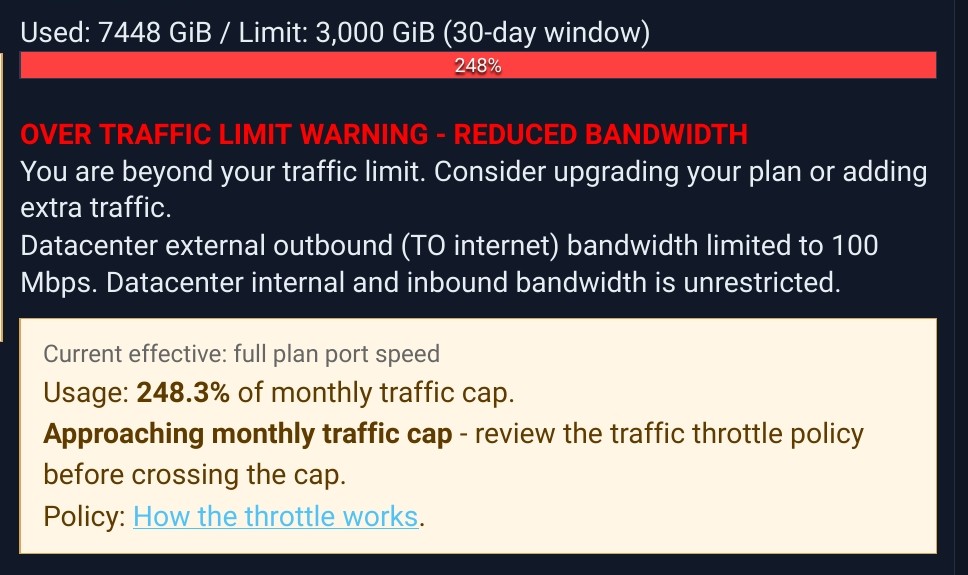
    Yup. That's silly. 2TB is small. Streaming 4K HDR alone could bust it in less than 5 day. Doesn't make sense for big provider like Comcast to do that.
  • rustelekomrustelekom Patron Provider, Veteran

    For me, unmetered traffic means exactly what the word itself implies: under any circumstances, you won’t receive a bill for thousands of dollars for exceeding the traffic limit.

    The exact value of the limit (which, of course, still exists and is used by the hosting provider for internal purposes) depends on the situation in the company: how many dollars they pay for traffic to the upstream provider, what volume of traffic is allocated to a specific node, and what the overall situation with traffic consumption is at that specific node.

    It’s simpler and more honest to simply offer a VPS with limited traffic to those who want to know how much traffic they can use. Users who use traffic for typical purposes usually don’t exceed the limit of 2–5 TB per month, but these typical purposes are very individual.

    The client can independently choose one of the many plans with traffic:

    a) unmetered
    b) limited
    c) guaranteed

Sign In or Register to comment.