


























New on LowEndTalk? Please Register and read our Community Rules.
All new Registrations are manually reviewed and approved, so a short delay after registration may occur before your account becomes active.
All new Registrations are manually reviewed and approved, so a short delay after registration may occur before your account becomes active.
Anyone planning hosting business using old Mobiles?

it was fun to see there's a hosting using RPIs.. many old mobiles are way more powerful than RPIs and competitively so with many an older and even mid-tier xeon (1 cpu VS 1 cpu). anyone here working on such a project? could just put up a rack right at home..
probably don't even need to invest in mobiles, - everyone's easily got a dozen or so stashed in the desk somewhere.. i personally think it's a waste to get measly $40 discount on new phone by trading in the previous model that's still working great and has a scratch somewhere or whatnot..
https://research.google/blog/a-low-carbon-computing-platform-from-your-retired-phones/



Comments
Good luck
They are unsafe to keep plugged in 24/7 for months with the battery still inside, and in modern ones it would be a hassle to remove, and regardless, they are not designed to even turn on without one, so it would need some schematic hacks and soldering.
At which point a question arises, are you really saving money, when each single phone needs so much work on it to be usable in this scenario.
Further, everything is locked down and boots Android only. Even if you manage to set up a chroot, the kernel still can't be replaced and has so many limitations. Maybe you can run some of your own tasks and services on it, but selling anything like that to customers is out of the question.
Yup - in the Google project they're removing the batteries because it would be a huge fire hazard in a data center.
You can sell your old phone, e.g., on Swappa instead.
It comes to mind, now that EU mandates replaceable batteries, they should have also mandated that a phone turns on and works without a battery, with the charger connected. But probably too clueless for that. Meanwhile it would be really dead simple to implement for vendors, I had an old tablet which was able to work like that simply from the factory.
it's just a hypothetical. not only i am not planning to do this myself, i simply wouldn't know where to start.. well, start with the article.. ok, i know where to start.. but then i wouldn't know where to continue. this is just an entertaining idea, nothing else.
Start with proxidize and start selling mobile proxies ! Huge business @bchot
Start with something called box phone farm, they're phone motherboard connected to power and USB, the old one are pretty cheap.

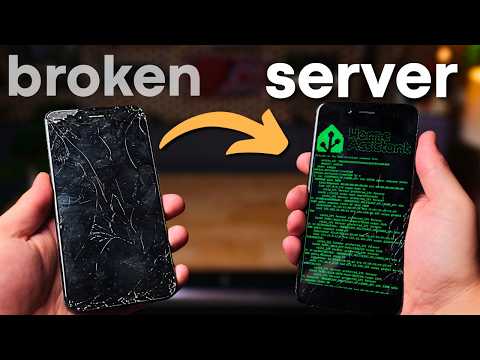
Next, you'll need an operating system, since the one on the phone are restrictive and outdated. PostmarketOS are the most popular option, the Galaxy J7 Prime above is well supported and included in the mainline kernel. You just need to flash the image and done.
Finally, Hardware Haven made a great video about this topic:
i am a coder, i am not a solder (sodder).. i enjoy putting together a new PC, or swapping parts every once in a while, but this is as far as my hardware experiments go.
although this here is a great video, thanks!
Yeah, as nice as the idea is the batteries will be a major problem one way or another.
I don't follow phones all that closely but from my impression there's at least a bunch that would be unlockable. Chroots are kinda laughable when it comes to hosting anyways. Drivers should be usually available somewhere and would just have to be ported (more or less depending how much of its own flavor Android adds there).
So for a limited amount of models it might at least theoretically work but it's pretty safe to say that it would still be a lot of work to figure everything out. If there's any potential in it it would probably need someone to specialize on exactly that and later cash in on the research investment.
This is the primary issue probably.
I thought about turning an older phone into a "custom Raspberry Pi alternative", but wasn't able to make it work without the battery even on a model with a removable one.
The most interesting part is how they make the phones work afterwards.
I found a couple of tricks for portable LTE->wi-fi routers, but that obviously won't work on smartphones - the "firmware" is much more complex and just totally different.
Software is main issue... replacing the battery with a cap isnt hard
Plus arm64 sadly sucks so far
That's called a landline.
I don't think mobiles are designed for 24/7 usage and likely thermally limited. Helps they removed all the unnecessary shit, but they were doing it for science, not cost.
I still have a white burn mark on a fingertip for picking up a Samsung J7 on fire and smoke and throwing it into a metal bucket, then hurled the bucket from the basement to the backyard...
Happened last week and I have a new phone now
Wait I'm gonna take pics the world ought to see
PICS!!!
Sorry if this is overly obvious but have you tried simply soldering a power supply with roughly matching voltage to the contacts?
That's correct. Mobiles are designed for extremely low idle power consumption and relatively high processing power at short bursts. They actually do this by using separate classes of CPU cores, often three different classes. They can't handle running their high performance cores for very long without overheating and going into extreme thermal throttling, and their low performance cores are not capable of doing much more than simple background tasks.
In a way, a mobile is the exact opposite of what you want in a server. Mobiles are only intended for heterogeneous loads (switching between periods of extreme inactivity and periods of brief heavy use), whereas servers are designed to operate efficiently at one consistent workload indefinitely.
I don't think there's any smartphone that allow you to run just from the phone charger, your best bet is solder the charger cable to the battery controller with a diode in the middle to drop the voltage down to 4V, which ironically is easier on the non removable batteries one.
My "oldoldphone" (in Debian terminology) with a couple of extra diodes and a prosthetic battery:
It died two years ago but it passed peacefully and in silence, unlike the J7 above which went like a suicide bomber. Imagine driving 500 kilos of lithium batteries on wheels, if it goes wrong you have no more than three seconds to get out of the car, the amount of heat a failed battery releases is unmanageable. Compound with electronically controlled door latches, if those fail to open, you dead.
There's nothing stopping people from adding more cooling. It obviously won't make a non-ideal design ideal but would likely stop them from dying/throttling. How much space/power this would waste is another question though. Removing cases and putting them inside some strong airflow probably wouldn't be too bad but if it takes an actual dissipator things start to get a little clunky.
(Disclaimer: I'm not being overly serious here)
I'm not sure how well the actual chipset itself is able to dissipate heat internally. It might be that the core temperatures rise too high well before the case temperature gets hot enough to transfer heat to any kind of DIY heat sink.
It surely would help though! You could even do it with passive cooling. I read somewhere that someone got an RTX 3090 GPU to run at full power (hundreds of watts) using 100% passive cooling with a giant heat sink and no fans. Crazy.